December 18, 2025
By Dana Greeley
Member, Jackson Park Men’s Golf Club
If you find yourself having a birdie-less day on the course and you don’t want to spoil a good walk … there are usually real-life birds to hear and see.
Here’s a quick snapshot/hole-by-hole guide to some of the birds found at Jackson Park Golf Course.
On the way up to the clubhouse, near the area of the rental pull carts, look in the trees in the springtime and you may see a Red-breasted Sapsucker pounding away on the trees.
Driving Range
While hitting that warm-up bucket and dreaming of upcoming eagles during your round, scan the sky for what is likely your only eagle of the day, the Bald Eagle.
Front Nine
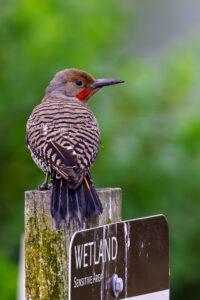
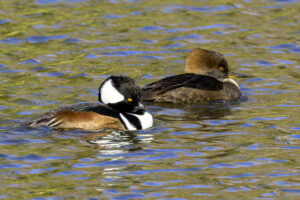
The 1st hole is a good chance to hear (and possibly see) a Pileated Woodpecker. Another woodpecker, one often cursed for drilling into the side of your house, is the Red-shafted Northern Flicker. This species can be seen all over the Seattle area, but lately seems to like (in addition to ants) the area around the 2nd hole. The pond down at the bottom of the 3rd hole is not only a great area to collect your wayward shots; it’s also a good place to see a Hooded Merganser.
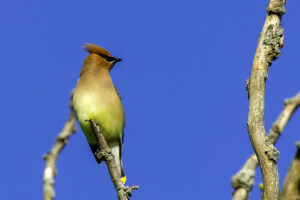
Hole No. 4, when that semitruck on the freeway isn’t downshifting in your backswing, offers a chance to hear the faint high call of the Cedar Waxwing. The 5th fairway is a favorite haunt of the American Robin, also known by its Latin name: Turdus migratorius. The left side of the 6th fairway is a good spot toward which to aim your drive, but if you happen to end up a bit farther left, the trees are a good place to see and hear the Red-breasted Nuthatch. As you are sometimes apt to wait on the 7th tee, scan the sky for possible migrating Turkey Vultures.
The 8th hole seems to be a good spot to hear the raucous call of the Steller’s Jay – RIGHT IN THE MIDDLE OF YOUR BACKSWING!!! Behind the 9th tee one can often hear, if not see, Kinglets, both Ruby-crowned and Golden-crowned.
Back Nine
The 10th tee box is a notorious spot for the Jackson Park Crow. You may hear a golfer yell fore, but more likely the uninitiated will be yelling, “That damn bird’s got my hot dog!”
The trees right of the green on No. 11 are a good spot for the House Finch. Often flying low over the ground on the fairway of the par-five 12th are Barn Swallows, catching bugs on the wing. The trees behind and around the 13th tee often hold Washington state’s official bird, the Goldfinch. To the left of the 14th tee has been the on-again, off-again nesting site of a Cooper’s Hawk, and further in the past the closely related Sharp-shinned Hawk. Also on the 14th, while searching for your playing partner’s ball in the pond, be on the lookout for a smallish duck called the Lesser Scaup. The trees between the 15th and 6th fairways are a locale for wayward golf balls, but also for both Hairy and Downy Woodpeckers. Whether you drive into the pond or hit the middle of the fairway on No. 16, look up beyond the green to find a favorite nesting area for the Red-tailed Hawk. While not as common as hitting the green on No. 17, on more than one occasion I’ve heard a Western Wood-Pewee in the trees right of the green. Down in the pond between the 18th and 1st fairways one can usually see many water birds; one of my favorites to hear and see is the tiny Pied-billed Grebe.
Your round is over and you’re loading up your car. Be on the lookout for a tiny falcon called a Merlin. They occasionally make fly-bys through the parking lot looking for small birds and large insects to eat.